
Trauma Informed Practice – Creating safer, more supportive environments
12.11.2025
Regulation 32 Requirements Explained for Supported Accommodation
11.12.2025
Children’s Social Care in England 2025
What the data reveals and how Mentor helps providers thrive
Official UK government data for 2025 paints a clear picture: children’s social care in England is growing fast, adapting to new regulation and working hard to meet rising demand. From the increase in children’s homes to the rapid rise of supported accommodation, the sector continues to evolve and providers are being asked to do more, with greater transparency, than ever before.
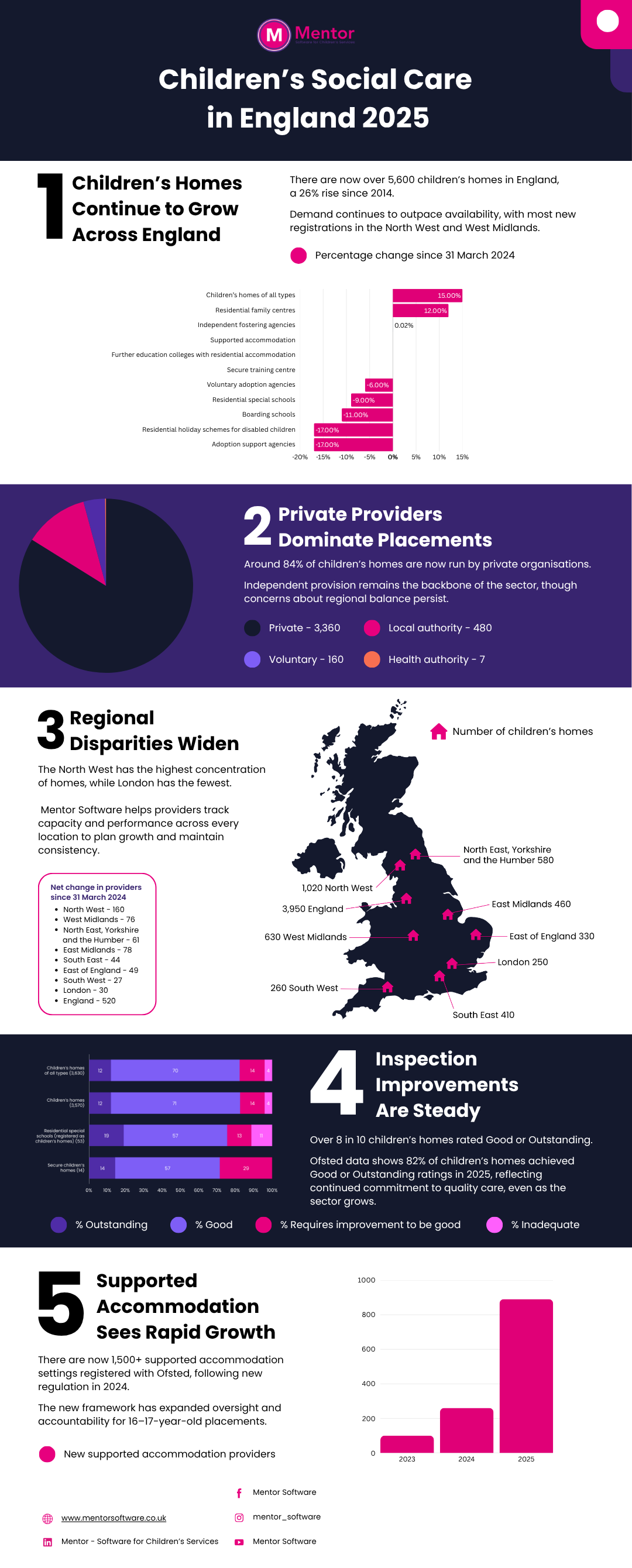
At Mentor Software, we’ve taken the latest national statistics and transformed them into a clear visual infographic to help providers understand what’s changing, what’s improving and where pressure is building. Beyond the data itself, this year’s trends highlight something bigger: the increasing need for strong governance, real-time oversight, and consistent recording — especially for providers running multiple homes.
1. Children’s homes continue to grow across England
There are now over 5,600 children’s homes in England — a 26% increase since 2014. Growth remains strongest in the North West and West Midlands, where new registrations continue to outpace other regions.
For providers, this growth brings huge opportunity but also increased complexity. More homes means more staff to support, more policies to maintain, and more variation in local authority requirements.
Mentor makes a difference here. Our real-time dashboards allow providers to track capacity, performance and compliance across every location in one connected view. Whether you’re opening your second home or your twentieth, you can scale with confidence knowing every site meets the same standard.
2. Private providers now deliver most placements
Around 84% of children’s homes in England are now run by private organisations. Independent providers are meeting the majority of placement needs, bringing new investment and flexibility to the sector.
This means Ofsted expects even stronger group-level oversight, consistent policies, and clear evidence that leadership teams know their homes inside out.
Mentor gives multi-home providers the governance infrastructure they need. Leaders can view incidents, staffing levels, audits and outcomes across all homes at once — helping Responsible Individuals and senior teams demonstrate the strategic oversight inspectors want to see.
3. Regional disparities are increasing
The North West now has the highest concentration of children’s homes, while London continues to have the fewest. This uneven spread creates pressure points for placement sufficiency and makes staffing, recruitment and matching more challenging in some areas.
Mentor helps providers navigate these regional differences. Our platform brings together occupancy, trends, risk alerts and regulatory actions across every home, giving large organisations the visibility they need to plan staffing, budgets and new openings based on reliable data.
With Mentor, leaders can maintain consistency and oversight even when homes are spread across multiple local authorities and regions.
4. Inspection ratings remain strong
Despite rising demand, the sector continues to deliver strong outcomes: 82% of children’s homes were rated Good or Outstanding in 2025.
This stability reflects real effort from teams working under pressure and stronger internal governance across many providers.
Mentor helps sustain and strengthen these outcomes. By centralising daily logs, incidents, medication records, audits and reports, the system ensures evidence is always organised and inspection-ready. Teams can demonstrate impact clearly, and leadership can spot patterns early enough to act. Consistent recording leads to consistent care — Mentor helps make that a reality.
5. Supported accommodation shows rapid expansion
One of the biggest shifts in recent years has been the regulation of supported accommodation for 16–17-year-olds. Since Ofsted registration became mandatory in 2024, more than 1,500 settings have now registered.
The new framework raises expectations around safety, staffing, oversight and outcomes. Providers now need the same level of evidence and audit that children’s homes require.
Mentor’s supported accommodation tools are designed for this exact purpose. Providers can digitise risk assessments, daily notes, independence planning and compliance evidence, helping teams stay aligned with Ofsted’s standards and demonstrate strong governance from day one.
As the sector grows, so does scrutiny. Ofsted’s guidance is clear: large providers must show group-level visibility over safeguarding, quality, trends and risk. Manual systems can’t keep pace with the oversight expectations placed on today’s multi-home organisations.
Mentor solves this by offering:
- Real-time dashboards across homes
- Automated audit reminders
- Linked incidents, actions and training
- Centralised policies and document control
- Unified reporting for Responsible Individuals and senior leaders
What this all means for providers in 2025
The data tells a consistent story: children’s social care is expanding, adapting and under pressure but also improving, innovating and delivering strong outcomes.
Providers who succeed in this landscape will be those who combine:
- Clear oversight
- Consistent recording
- Data-driven decision making
- Strong organisational culture
Mentor gives teams the tools to achieve all four, helping organisations stay compliant, improve safety and deliver excellent care every day.
See the visual breakdown of all five insights here:

Ready to strengthen oversight across your homes?
With more than 5,600 children’s homes now operating in England and supported accommodation growing faster than ever, providers need systems that can scale. Mentor Software gives you the visibility, consistency and evidence you need to stay ahead of demand, maintain quality across every location, and be inspection-ready every day.